Between Two Worlds, Beyond Both: How British-Asian Artists Are Forging an Entirely New Musical Language
There's a particular kind of pressure that comes with inheriting a musical tradition. When your grandmother sang classical Hindustani ragas in a front room in Lahore, and your uncle played dhol at every wedding from Oldham to Oslo, and your parents still have cassette tapes of Nusrat Fateh Ali Khan stacked next to the television — what exactly are you supposed to do with all of that?
For a growing number of British-Asian artists, the answer is: absolutely everything.
Forget the tired narrative of East-meets-West, that well-meaning but slightly condescending framing that's haunted world music discourse since the 1980s. What's happening right now in cities like Birmingham, Leicester, Manchester, and East London is something altogether more complex, more layered, and more alive. A generation of producers, singers, and instrumentalists is taking South Asian musical heritage — classical Indian, Pakistani, and Bangladeshi traditions that stretch back centuries — and pushing it through entirely contemporary filters. Grime. Ambient electronics. Alt-R&B. Hyperpop. The results are sounds that don't sit comfortably anywhere, which is precisely the point.
The Map Has Always Been Messy
Migration, as any traveller knows, is rarely a straight line. You don't simply leave one place and arrive in another with your identity neatly packed and labelled. You carry fragments. You lose things. You pick up new ones along the way. The music being made by British-Asian artists today reflects that non-linearity with remarkable precision.
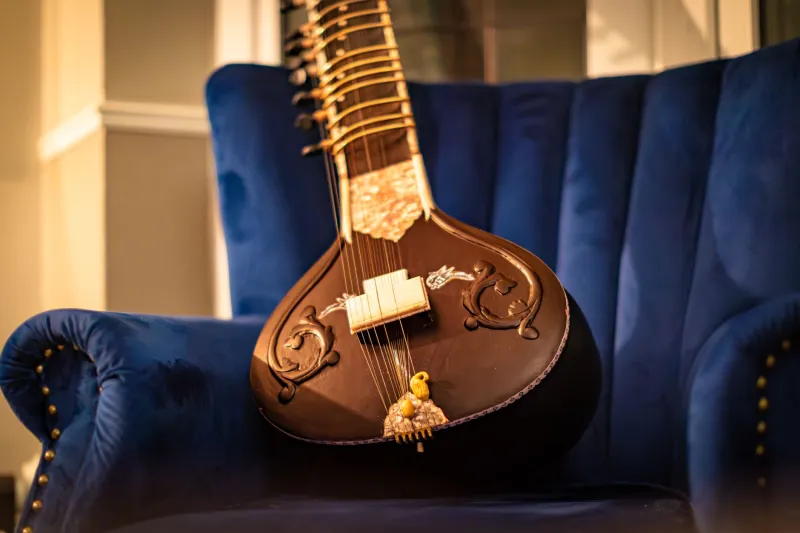
Take the work of producers working in the orbit of UK drill and grime who are quietly slipping sitar samples and tabla rhythms into their beats — not as gimmicks or exotic seasoning, but as genuine structural elements. The taal, the rhythmic cycle at the heart of classical Indian music, has an intricate, cyclical quality that maps surprisingly well onto the syncopated patterns of UK electronic music. Artists who grew up hearing both in their households aren't making a conscious artistic decision when they blend them. They're just making the music that sounds like their actual lives.
Similarly, the ghazal — that ancient Urdu and Persian poetic form built around themes of longing, love, and separation — has found unexpected new homes. Singers trained in its classical conventions are now performing over lo-fi production, over trap hi-hats, over drone-heavy ambient soundscapes. The emotional vocabulary of the ghazal, that specific ache of yearning for something just out of reach, translates almost too well into contemporary British-Asian experience.
Roots as Raw Material, Not Relics
What separates this movement from previous waves of South Asian crossover music is the refusal to treat heritage as something precious and untouchable. Earlier generations of British-Asian artists — the Bhangra explosion of the late 80s and 90s, the Asian Underground scene that followed — often operated with a certain reverence, a sense that the traditional elements needed to be handled carefully, presented respectfully.
The current generation has no such anxiety. They're pulling classical compositions apart at the seams, running vocals through vocoders, chopping up sarangi samples and reassembling them in ways that would horrify a purist and delight everyone else. There's a liberating irreverence at work here, one that paradoxically demonstrates a deeper confidence in the source material. You can only really play with something if you're not afraid of breaking it.
This isn't disrespect — it's ownership. These artists aren't borrowing from a foreign tradition; they're inheriting one. And what you inherit, you get to transform.
The Cities Are the Studios
It matters enormously where this music is being made. Birmingham's Sparkhill and Handsworth, Leicester's Belgrave Road, Manchester's Rusholme, Bradford's Manningham — these are communities with deep, decades-long connections to South Asia, places where Pakistani, Indian, and Bangladeshi cultural life has had time to settle, evolve, and develop its own distinct British character.
The music emerging from these spaces isn't trying to recreate something from back home, nor is it trying to assimilate into a mainstream British sound. It exists in a third space — culturally specific without being insular, globally informed without being rootless. Artists in these communities are just as likely to be listening to Arca or Burial as they are to Abida Parveen or A.R. Rahman, and that breadth of reference shows in the work.
London, naturally, adds its own dimension. The city's extraordinary density of South Asian communities — from Southall's Punjabi heartland to Tower Hamlets' Bangladeshi cultural hub — means that artists here are constantly in conversation with each other, cross-pollinating ideas across traditions that might not naturally overlap. A Bengali-British producer collaborating with a British-Pakistani vocalist trained in Sufi qawwali isn't a novelty in East London. It's just Tuesday.
Charting Territory That Didn't Exist Before
Perhaps the most striking thing about this musical moment is how little it seems to care about being understood by any single audience. These artists aren't making music for their parents' generation, and they're not particularly interested in educating non-Asian listeners about South Asian culture. They're making music for themselves and for the peers who share their particular, complicated, beautiful experience of being from here and from there simultaneously.
That specificity, counterintuitively, is what makes it so universally resonant. The feeling of being between things — between languages, between expectations, between the person your family imagined you'd be and the person you actually are — is not an exclusively British-Asian experience. But few musical movements are currently articulating it with this much precision or this much style.
For listeners willing to follow the sound wherever it leads, the rewards are considerable. This is music with genuine depth, genuine tension, and genuine joy — often all at once. It's the sound of people making sense of complicated lives through the most direct means available.
Which, when you think about it, is what all the best music has always been.
Where to Start
If this world is new to you, the entry points are easier to find than you might expect. Dig into the UK's independent music press, explore SoundCloud and Bandcamp for producers based in Birmingham and East London, and keep an ear on festival lineups — events like Mela festivals across the UK are increasingly booking artists who sit in exactly this space, alongside more mainstream acts.
The route isn't always clearly signposted. But then, the most interesting journeys rarely are. Follow the sound. See where it takes you.