Caravans and Chords: Tracing the Living Musical Legacy of the Silk Road
Imagine a playlist curated over two thousand years. No algorithm, no editorial team — just merchants, pilgrims, and wandering musicians carrying instruments across deserts and mountain passes, leaving fragments of melody wherever they stopped to rest. That, in essence, is the Silk Road. And the music it scattered across Central Asia, the Middle East, China, and the Mediterranean hasn't gone quiet. If anything, it's getting louder.
For UK listeners who've grown comfortable with the familiar geography of world music — a bit of Fela Kuti here, some Buena Vista Social Club there — the Silk Road represents a genuinely underexplored frontier. It's a corridor of sound that runs from Xi'an to Istanbul, threading through some of the most musically rich cultures on earth. The question isn't whether this music is worth your time. It's why it took this long to find it.
The Routes That Carried More Than Silk
The Silk Road wasn't a single path. It was a vast, shifting network of overland and maritime routes connecting the Han Dynasty's China with the Roman Empire, passing through Persia, the Steppe, the Indian subcontinent, and the Levant. Goods moved along it, yes — silk, spices, glass, paper — but so did ideas, religions, languages, and, crucially, music.
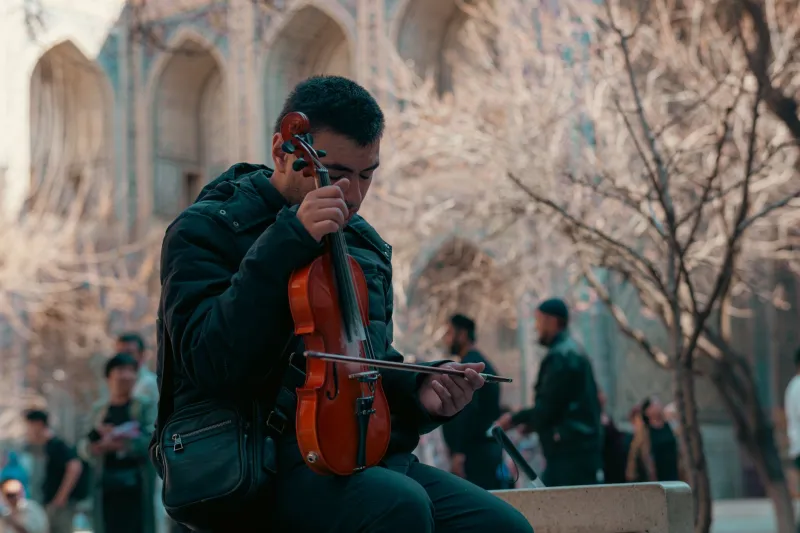
The lute, ancestor of the guitar and one of the defining instruments of Western classical music, almost certainly travelled westward from Central Asia along these routes. The oud, still central to Arabic and Turkish music today, shares a direct lineage with the Chinese pipa. The rubab, the national instrument of Afghanistan, has cousins scattered from Tajikistan to northern India. These aren't coincidences. They're evidence of centuries of cultural cross-pollination happening in real time, one caravan stop at a time.
Persian classical music — known as radif — developed in large part through this exchange. Its system of modal scales, called dastgah, reflects influences absorbed from neighbouring cultures over centuries. When you listen to a master like Shajarian performing in the Shur mode, you're hearing something that has been quietly shaped by musical ideas that once passed through bazaars from Samarkand to Shiraz.
Maqam, Modal Music, and the Thread Connecting Cultures
One of the most fascinating through-lines in Silk Road music is the concept of maqam — a system of melodic modes used across Turkish, Arabic, Persian, and Central Asian traditions. Think of it less like a Western scale and more like a musical personality: each maqam carries its own emotional character, its own rules for improvisation, its own sense of movement and resolution.
What's remarkable is how this single framework, with regional variations, stretches from Morocco to China. Turkish makam, Arabic maqam, Persian dastgah, and Uzbek shashmaqam are all branches of the same ancient tree. For listeners used to the relatively rigid structures of Western pop and classical music, encountering maqam-based music for the first time can feel genuinely disorienting — in the best possible way. Notes bend, rhythms breathe differently, and the emotional register operates on frequencies you didn't know you had.
A good entry point is the Kronos Quartet's collaboration with Alim Qasimov, the Azerbaijani master of mugham (the Azerbaijani variant of the tradition). It's accessible, but it doesn't flatten the complexity. From there, follow the thread to the Aga Khan Music Initiative's recordings of Tajik and Uzbek classical music — genuinely stunning, and available on most major streaming platforms.
Modern Artists Remixing the Caravan
Here's where things get really interesting for the contemporary listener. A new generation of artists across Central Asia, Turkey, Iran, and the diaspora isn't simply preserving these traditions — they're pulling them apart and reassembling them with electronics, jazz sensibilities, and global influences.
Turkish artist Mercan Dede (also known as DJ Arkin Re) blends Sufi music and whirling dervish rhythms with electronica in a way that shouldn't work but absolutely does. His sets feel like a late-night club in Istanbul where the 13th century wandered in and decided to stay. Similarly, the Iranian-Canadian composer Aroha Sheibani has been weaving Persian classical structures into ambient soundscapes that have found audiences far beyond traditional world music circles.
Closer to the eastern end of the route, Chinese-American pipa virtuoso Wu Man has spent decades bridging Tang Dynasty court music with everything from Appalachian folk to Mongolian throat singing. Her collaborations with Yo-Yo Ma's Silk Road Ensemble remain some of the most genuinely cross-cultural recordings ever made — and they're a brilliant gateway for UK listeners who want depth without a steep learning curve.
In Central Asia, look out for Huun-Huur-Tu from Tuva (yes, the tiny Russian republic near Mongolia), whose throat-singing traditions are so otherworldly they've attracted collaborations with Frank Zappa's former bandmates and the Kronos Quartet alike. Stranger still, and more wonderful for it.
Your Silk Road Listening Map
If you're ready to start following the sound, here's a loose geography to orient you:
Western end (Turkey & the Levant): Start with Mercan Dede, then explore the fasıl tradition through artists like Münir Nurettin Selçuk. For something more contemporary, the Istanbul-based label Doublemoon is an excellent resource.
The Persian corridor (Iran & Azerbaijan): Shajarian for classical depth, Googoosh for something more accessible and pop-adjacent, and Alim Qasimov for the rawest emotional power you'll find anywhere on this list.
Central Asia (Uzbekistan, Tajikistan, Kazakhstan): The shashmaqam recordings on the Aga Khan Music Initiative are essential. Also seek out Sevara Nazarkhan, who brings Uzbek folk into a more contemporary frame without losing its roots.
The eastern reaches (China & Mongolia): Wu Man and the Silk Road Ensemble, Hanggai (Mongolian folk-rock that's as exciting as it sounds), and the Beijing-based experimental label Maybe Mars for something more avant-garde.
The Silk Road was never really about a single destination. It was about what happened in between — the unexpected meetings, the borrowed melodies, the ideas that took root in foreign soil and grew into something new. That spirit of restless, curious exchange is exactly what Traveller Music is about. The caravan is still moving. You just have to decide whether to join it.