Petrol, Pastries, and Playlists: The Unlikely Musical Education Happening at Britain's Service Stations
There's a particular kind of exhaustion that belongs only to the motorway. You've been driving for two hours, the sat-nav has lied to you at least twice, and someone in the back seat has consumed all the snacks. You pull off at a service station — Watford Gap, perhaps, or Membury, or one of the dozen anonymous forecourts that punctuate the M6 like commas in a very long sentence — and you're not expecting much beyond a flat white and a toilet break.
But then something happens. A song comes on over the café speakers. You don't recognise it. You Shazam it. And twenty minutes later, standing in the car park with a lukewarm sausage roll, you're three albums deep into a Malian guitarist you'd never heard of before you pulled off the A1.
This is the motorway service station paradox: the places we dismiss most readily are, in their own strange way, becoming some of Britain's most democratic music discovery zones.
The Playlist as Portal
It sounds absurd, and yet the logic holds. Service stations are liminal spaces — not quite anywhere, not quite nowhere — and that in-between quality creates a peculiar openness in the people passing through them. You're not at home, scrolling your usual algorithm. You're not at a gig you've chosen. You're just there, suspended between destinations, and music arrives unbidden.
Curators in the hospitality industry have quietly cottoned on to this. Several of the larger service station operators now contract specialist playlist services — companies like Soundtrack Your Brand or similar — to craft sonic environments that feel less like supermarket background noise and more like considered editorial choices. The brief, often, is interesting but accessible. The result, at its best, is genuinely surprising.
"We were asked to avoid the obvious," says one music supervisor who works with a major UK forecourt operator, speaking anonymously because of contractual obligations. "No Ed Sheeran, no Adele — not because they're bad, but because everyone already knows them. The brief was to find things that feel warm and familiar but that people can't immediately name. That's actually a really interesting creative challenge."
The effect is more powerful than it sounds. When you hear something you can't name, your brain engages differently. You're not passively absorbing. You're listening.
The Touring Musician's Pit Stop
There's another dimension to this story that rarely gets told: service stations as waypoints in the lives of working musicians. For the thousands of independent artists crisscrossing Britain in transit vans — playing Exeter on Thursday, Sheffield on Friday, Aberdeen on Saturday — these places are practically a second home.
Bristol-based singer-songwriter Amara Diallo, who tours extensively across the UK with her blend of West African rhythms and British folk, describes service stations with an almost tender familiarity. "You get to know them. You have your favourites. There's one on the M5 where I always stop because the coffee is genuinely decent and there's a corner table where you can sit and write without anyone bothering you."
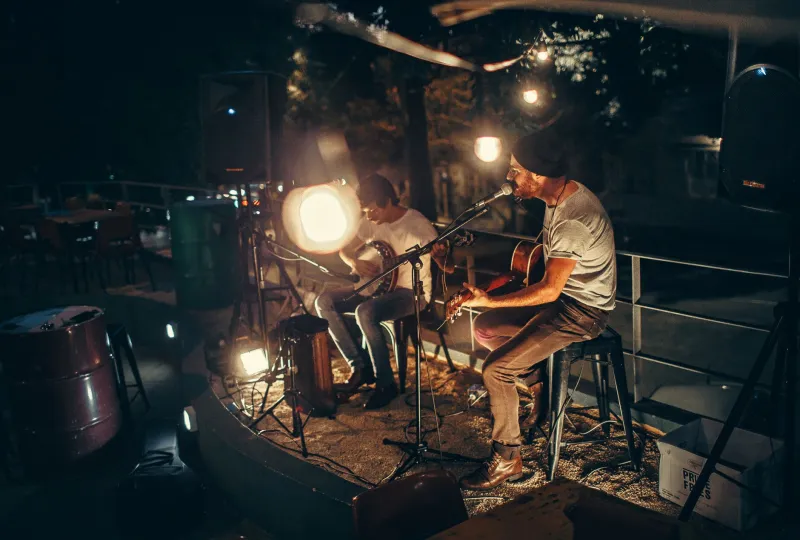
Amara also notes something more unexpected: the performances. Not formal ones, but the casual, spontaneous kind. "I've pulled out my guitar in the seating area a few times, just to stretch my fingers, and people gather. It's not a gig. No one's paid. But there's something about that neutral space — people are already a bit disoriented, a bit open — and they actually listen."
She's not alone. A loose, informal network of touring artists has begun to share notes online about which service stations are most receptive to impromptu playing. Some staff turn a blind eye. A few actively encourage it. One venue manager at a Moto site in the Midlands told us, off the record, that they've had "more than a few memorable afternoons" when musicians have set up informally in the food court.
Algorithms Don't Stop Here
What makes all of this culturally significant — beyond the novelty — is the contrast with how most Britons now encounter music. Streaming algorithms are extraordinarily good at giving you more of what you already like. They're considerably less good at ambushing you with something genuinely alien to your tastes.
Service stations, by contrast, offer no personalisation whatsoever. The playlist doesn't know you. It doesn't know whether you're a 19-year-old heading to a festival or a 58-year-old driving back from a sales conference. It plays what it plays. And occasionally, it plays something that changes how you hear the world.
This is, in its own low-key way, a form of cultural serendipity that's becoming increasingly rare. The music journalist and broadcaster Gilles Peterson has spoken about the importance of "friction" in music discovery — the idea that stumbling across something unexpected, without the guardrails of algorithmic recommendation, produces a more lasting and transformative connection. Service stations, of all places, deliver that friction by the bucketload.
Reading the Room on the Road
None of this is to romanticise the motorway service station beyond all recognition. They remain, fundamentally, places of transaction — overlit, over-branded, and almost aggressively utilitarian. The music playing in the background is not curated for your personal enlightenment.
But the traveller who stays curious — who pulls out their phone, who follows the thread, who lets a stranger's playlist become a doorway — finds something the algorithm never quite delivers: surprise. And surprise, in music as in travel, is where the real education begins.
Somewhere on the M1 right now, a lorry driver is hearing Tinariwen for the first time over a service station tannoy. A student on her way home for Christmas is Shazam-ing a Lebanese jazz quartet. A family, bickering about which services have the best toilets, is being briefly, beautifully interrupted by something none of them expected.
Britain's roads are long. Its service stations are many. And the music, if you're paying attention, is everywhere.