When Home Becomes a Song: The Refugee Artists Transforming Britain's Music Scene
There's a particular kind of music that only displacement can create. It carries the weight of everything left behind — the street sounds of a city now bombed to rubble, the wedding songs of a community scattered across continents, the lullabies that exist now only in memory. But it also carries something else: the restless, searching energy of someone building a new world from the fragments of the old one.
Across Britain, a generation of musicians who arrived as refugees are making exactly that kind of music. And it's reshaping the cultural landscape in ways that most mainstream conversations about British identity haven't yet caught up with.
More Than a Backstory
It's tempting — and reductive — to frame these artists purely through the lens of their journey to the UK. The danger with that framing is that it flattens them into symbols rather than musicians. Amjad Ali, a Syrian oud player now based in Manchester, is refreshingly blunt about this.
"People want to hear the refugee story first," he says. "But I didn't come here to be a story. I came here to play music. The story is in the music — if you listen properly."
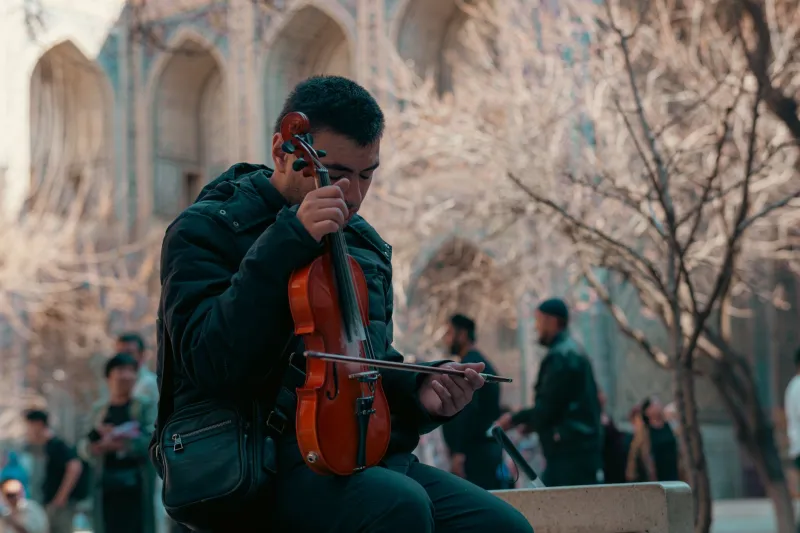
Amjad arrived in the UK in 2016 after spending two years in a camp on the Greek island of Lesbos. He'd been a professional musician in Damascus, performing at weddings and cultural events. In Manchester, he found a city with a thriving independent music scene and, crucially, a community of musicians curious enough to collaborate. His current project — a quartet blending Arabic maqam scales with Northern soul influences — has performed at Bluedot Festival and supported acts at Band on the Wall. The music is genuinely startling: mournful and danceable at once, ancient and urgent.
"The oud doesn't have frets," he explains. "It lives between notes that Western music doesn't have names for. When you put that next to a Hammond organ or a funk bassline, something new happens. I didn't plan it. It just happened from living here."
The Cities Doing the Heavy Lifting
Britain's major cities — Manchester, Birmingham, Bristol, Glasgow, and London in particular — have long functioned as pressure cookers for musical innovation precisely because of their diversity. But what's happening now feels distinct from earlier waves of multicultural influence on British music. These aren't second-generation artists negotiating between their parents' culture and their own British upbringing. These are musicians who formed their entire musical identity elsewhere, often in conservatoires or traditional apprenticeships, and are now transplanting those roots into entirely different soil.
In Birmingham, Eritrean musician Selam Tesfaye has built a following that extends well beyond the city's sizeable East African community. Her music draws on the pentatonic scales of traditional Tigrinya folk songs, layered over electronic production influenced by the UK's own rich heritage of jungle and two-step. She's released two EPs through a small Birmingham label and recently performed at Womad — one of the few festivals in Britain genuinely equipped to contextualise what she's doing.
"British audiences are more ready than people think," she says. "They don't need everything explained. They feel it first. That's the same everywhere — music goes in through the body before it goes in through the head."
The Institutions Catching Up
For years, the infrastructure around refugee musicians in the UK was almost entirely charitable in character — well-meaning but often patronising, treating artists as beneficiaries rather than professionals. That's slowly changing.
Organisations like Counterpoints Arts and the Migrants in Culture network have pushed hard for a shift in how the cultural sector engages with displaced artists — moving from welfare-adjacent programming to genuine commissioning, residencies, and career development. Music venues and festivals are beginning to follow.
Womad, Moseley Folk, and Celtic Connections have all, in recent years, made meaningful efforts to platform artists with refugee backgrounds — not as a tokenistic gesture, but as a recognition that these musicians represent some of the most interesting work being made anywhere. The programming choices are catching up with what's actually happening at grassroots level, in community halls, independent venues, and on SoundCloud pages with thousands of listeners and no PR budget.
The BBC has played a role too, albeit unevenly. BBC World Service and BBC Radio 3's Late Junction have both championed artists in this space, while mainstream Radio 1 and Radio 2 remain largely oblivious. The gap between what's available and what gets amplified remains frustratingly wide.
What Displacement Actually Does to Music
There's a musicological argument to be made here that goes beyond the personal and the political. Forced migration has historically been one of the great engines of musical evolution. The African diaspora produced jazz, blues, soul, reggae, and hip-hop. The Jewish diaspora reshaped classical music, cabaret, and Broadway. The Irish diaspora helped invent country music. In each case, the collision of a carried tradition with a new environment produced something neither could have generated alone.
What we're witnessing now — with musicians from Syria, Eritrea, Afghanistan, Somalia, Sudan, and elsewhere building new lives and new sounds in British cities — is another chapter in that long, painful, generative story.
Karwan Marouf, a Kurdish-Iraqi musician based in Glasgow, puts it simply. "When you lose everything, music is what's left. It's the one thing they can't take at the border. And when you arrive somewhere new, it's the first thing you use to say: I'm here. I exist. This is who I am."
His project, which fuses traditional Kurdish dengbêj vocal storytelling with electronic soundscapes, has attracted attention from labels in Berlin and Toronto as well as a devoted following in Glasgow's independent music scene. He performs with a rotating cast of Scottish musicians who, he says, bring an openness to collaboration he didn't expect.
"Scottish traditional music has its own relationship with loss and history," he reflects. "There's something that connects. We don't always need words for it."
Following the Sound
At Traveller Music, we talk a lot about following the sound — letting music lead you somewhere you wouldn't otherwise go. These artists are doing something even more fundamental: they're following the sound to survive, to remember, and to reinvent.
Britain has always been shaped by arrivals. Its musical identity — from the skiffle boom to jungle to grime — has never been the product of a single, settled culture. It's been built in the friction between what people brought with them and what they found when they got here.
The refugee musicians making their mark on British stages right now aren't a footnote to that story. They're the next chapter. And if you haven't been paying attention, you're already missing some of the most extraordinary music being made on these islands.
Start listening.