Slow Boats, Loud Songs: Aboard the Crossings Where Britain Still Sings at Sea
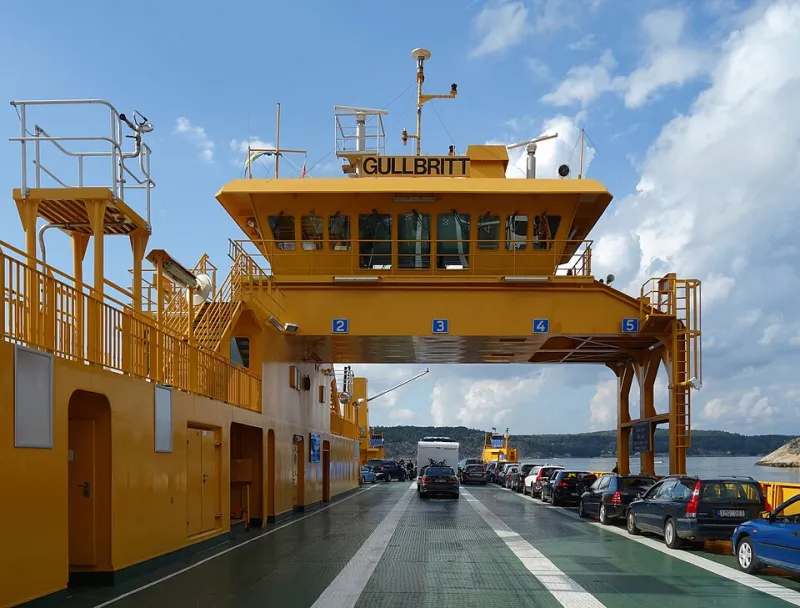
Photo: W.carter, CC BY-SA 4.0, via Wikimedia Commons
There's a moment on the Heysham to Douglas crossing — usually somewhere past the Isle of Man's wind farm, when the cabin's gone quiet and the tea trolley's done its rounds — where somebody inevitably starts humming. It might be a shanty. It might be something older than anyone can name. And for the duration of those three-odd hours, the ferry becomes something no Spotify playlist can replicate: a listening room that rocks.
We're losing these moments. Not dramatically, not with headlines, but route by route, timetable by timetable.
The Fastest Crossing Is the Quietest One
Something curious has happened to British sea travel. As crossings have got faster — Dover to Calais in ninety minutes by ferry, barely longer by train underneath the water — the journey has stopped being a place and become a corridor. Nobody lingers. Nobody talks to strangers. The onboard bar, once a venue in its own right, is a place you pass through on the way to duty-free.
Compare that with the slow routes still hanging on at Britain's edges. The Hebridean ferries — Oban to Barra, Ullapool to Stornoway — are five, six, seven hours of open water. CalMac crews will tell you the old hands know every song in the crew mess. Passengers on the Barra run have been known to strike up a tune in the observation lounge as the Sound of Arisaig slides past, and no one bats an eyelid. Out there, the crossing is still an event, and events get soundtracks.
There's a practical reason, too: these waters demand attention. A song sung on a slow boat has time to breathe in a way a three-minute pop song on a ninety-minute dash simply doesn't.
Shanty Country: The Isle of Man's Unexpected Revival
The Douglas crossing has become an unlikely flashpoint for the sea shanty revival that TikTok accidentally ignited in 2021. Local singers like the members of the island's thriving folk scene — a scene far bigger than a island of 84,000 people has any right to produce — have been staging impromptu sessions on sailings during the annual Yn Chruinnaght festival, the Manx gathering that celebrates the island's own distinct musical tradition.
What's striking is how young the audiences are. The stereotype of the shanty singer as a bearded retiree with a tankard doesn't survive contact with the ferry bar on a festival weekend. There are teenagers there who can sing "Hieland Laddie" in Manx Gaelic, a language that was very nearly lost and is now, improbably, being sung back to life a few miles offshore.
One crew member we spoke to, who's worked the Heysham route for two decades, put it beautifully: "The sea gives you time. Time to listen, time to sing badly, time to sing well. You don't get that on a train."
The Songs That Map the Water
Hebridean ferry music operates on a different register entirely. The Gaelic psalm singing of the islands — that extraordinary, keening, line-by-line style known as precenting — developed in communities where the sea was never far from the door. Hear it performed in a Stornoway church or, better still, hummed quietly by an elderly passenger watching the Minch darken, and you understand that this music wasn't written for concert halls. It was written for weather.
The ferry itself has long been a musical institution. Crews on the Skye routes talk of the days when the crossing to the Small Isles carried musicians to ceilidhs on Eigg and Muck, the deck doubling as a rehearsal space. Some of those traditions persist in miniature: the odd accordion produced from a holdall, a chorus taken up by strangers who were strangers forty minutes earlier.
What We Lose When the Routes Close
Britain has lost a startling number of ferry routes in the past thirty years. Steamer services that once stitched together the coast — the paddle steamers, the pleasure boats, the cargo vessels that carried both goods and songs — have mostly vanished. Each closure didn't just remove a transport link. It removed a listening environment: a unique acoustic space, part waiting room, part chapel, part pub, where people had nothing to do but be present.
The irony is that we've never had more access to music. We can carry fifty million songs in our pockets across the Irish Sea. But the pocket playlist is a private experience. The ferry session is a communal one, and communal music is precisely the kind that doesn't survive without a venue.
So here's a modest proposal for your summer: take the slow boat. Book the long crossing, not the fast one. Put the phone away, buy a tea, and see what happens when you give a boatload of strangers three hours and a shared horizon. Somewhere between the mainland and the island, somebody might start singing.
And you'll have been there for it.