Dorm Room Diplomacy: The Hostel Jam Sessions Quietly Changing How British Travellers Hear the World
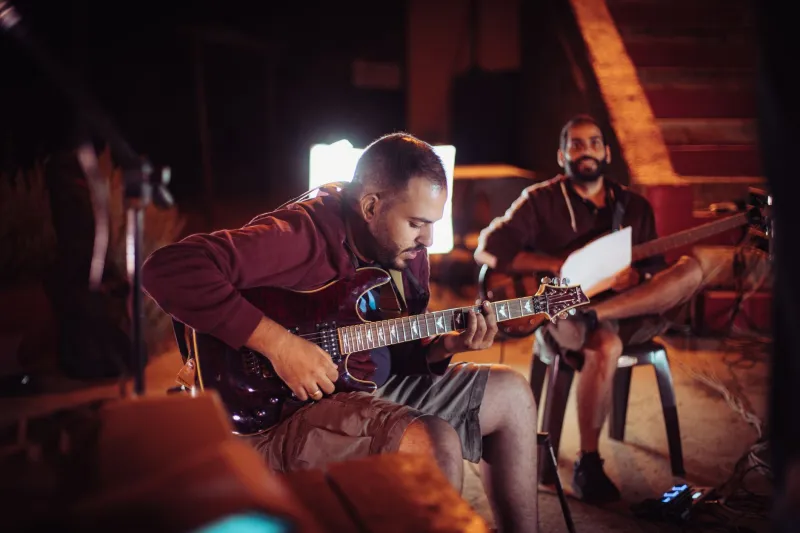
It usually starts with a guitar that belongs to nobody in particular. It lives in the common room, or propped against the kitchen wall, or hanging from a hook near the reception desk with a handwritten note that says something like 'play me' in three languages. Someone picks it up, starts playing something — a chord progression they've been working on, a song they know, something half-remembered from a set they saw last week. Someone else recognises it, or doesn't, but sits down anyway. A conversation starts. Then a collaboration. Then, sometimes, something that neither person expected.
This is how a significant number of genuinely interesting musical projects have begun — not in studios, not at industry events, not through carefully cultivated networking, but in the low-ceilinged common rooms and sun-baked courtyards of hostels from Tbilisi to Medellín, Chiang Mai to Porto. And British travellers, who remain among the world's most enthusiastic budget tourists, are disproportionately present at these moments of accidental creation.
The Invisible Infrastructure of Musical Exchange
There's an informal but surprisingly robust ecosystem that operates within the hostel circuit. It's not organised — nobody's running a programme or writing a grant application for it. It exists because of a confluence of factors that hostels happen to create: people with time on their hands, a degree of social openness enforced by shared spaces, the lowered inhibitions that come with being away from home, and the reliable presence of instruments, both brought and borrowed.
Local musicians, particularly in cities with strong tourist economies, often treat certain hostels as informal performance spaces. The economics make sense: a hostel common room full of international travellers is a genuinely multicultural audience, receptive in ways that local venues sometimes aren't, and the social setting encourages the kind of extended conversation about music that rarely happens at a ticketed gig. For emerging artists in cities where the formal music industry is limited or gatekept, the hostel circuit offers something valuable: direct access to an international audience and, crucially, to other musicians.
"I'd play in the hostel bar most weekends for almost two years," says Nino Kvaratskhelia, a guitarist and composer from Tbilisi who blends traditional Georgian polyphony with jazz improvisation. "The British travellers were always the most curious. They'd ask questions, want to know about the scales I was using, the history of the music. Some of them were musicians. Some of them came back."
Some of them, it turns out, came back with record deals.
When the Jam Session Becomes a Band
The story of how London-based quartet Supra came together reads like a travel memoir that accidentally became a press release. Drummer Caitlin Marsh from Sheffield was six weeks into a solo trip through the Caucasus when she ended up in the same Tbilisi hostel as Kvaratskhelia, who was playing an informal set in the courtyard. She sat in on percussion. They played for three hours. She extended her trip by two weeks.
"I knew nothing about Georgian music before that trip," Marsh says now. "I knew it existed, I think, in the vague way you know things exist. And then I was inside it, learning it, playing it. By the time I went home I had about forty voice memos on my phone of ideas we'd been working on together."
Those voice memos became the foundation of Supra's debut EP, released independently in 2022 and subsequently picked up for distribution by a London-based world music label. The band — completed by two further musicians, one British, one Georgian, both of whom also met through the same Tbilisi hostel scene — has since toured the UK and appeared at several festivals. Their sound is genuinely difficult to categorise, which is precisely its appeal.
"People ask what genre we are and we never have a good answer," Marsh says. "Which I think is correct. We didn't start from a genre. We started from a courtyard and a guitar."
The Role of the Space Itself
What hostels offer that most formal music venues don't is duration. A gig lasts ninety minutes. A hostel stay lasts days, sometimes weeks. The relationships that form in that extended time are qualitatively different from the transactional encounter of a live show. You eat breakfast with someone. You share a bathroom. You have the 2am conversation that only happens when you're both slightly lost in a foreign city. The musical exchange that emerges from that context carries a weight that a playlist or a live set can't quite replicate.
This is something that several hostel owners and managers have begun to consciously cultivate. In Medellín, a hostel called La Cueva has developed a reputation for hosting weekly sessions that bring together travelling musicians and local artists from the city's thriving indie and cumbia scenes. In Porto, a guesthouse near the Ribeira has become an informal hub for fado musicians looking for international collaborators. In Bangkok, a hostel in the Banglamphu area maintains a recording setup — basic but functional — that guests are free to use, and the resulting collaborations have produced music that's been released on Bandcamp, SoundCloud, and, in a few cases, proper labels.
"We don't advertise it as a music thing," says the Bangkok hostel's owner, who asked not to be named. "We just make the space available. But musicians find each other. They always do."
What Comes Back to Britain
For British travellers who pass through these spaces, the musical education is often lasting in ways that other tourist experiences aren't. You can visit a museum and forget what you saw within a fortnight. But a melody you played with a stranger in a Tbilisi courtyard at midnight, a rhythm you learned from a musician in a Medellín common room — these tend to stick.
They come home in the music British artists make. They come home in the records people seek out, the gigs they attend, the artists they tell their friends about. They come home as a changed relationship with music that doesn't sound like home.
None of it is planned. None of it is curated. It happens in the gaps — between destinations, between plans, in the hours when the itinerary runs out and you're just sitting somewhere with time and a borrowed guitar and someone who wants to play.
That's not a bad definition of how music has always worked, actually. The hostel just happens to be where it's happening right now.