All Aboard the Underground Canon: The Rail Lines That Quietly Built Britain's Most Radical Music Scenes
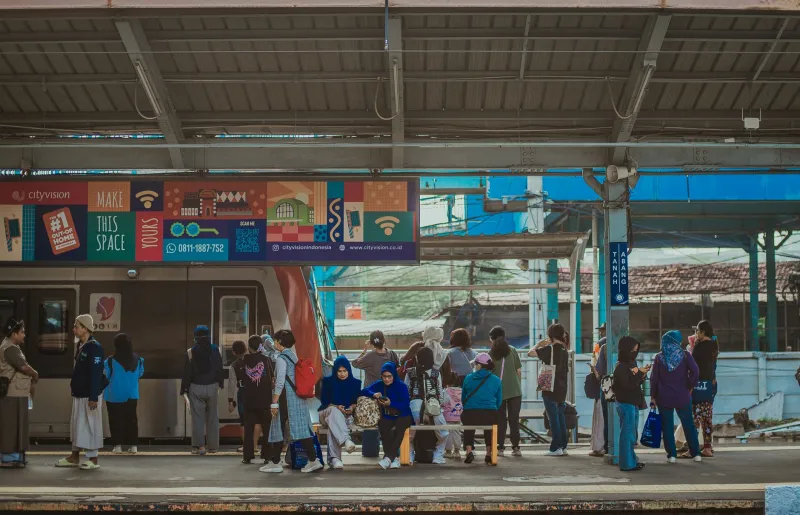
Long before Spotify algorithms told you what to listen to next, Britain's railway network was doing something far more interesting — accidentally engineering some of the most vital musical communities the country has ever produced. From the platforms of New Street to the terrace houses off the Westway, the story of post-war migration is also, quietly, a story about sound.
We talk a lot about music scenes as if they emerge from pure creative will — as if a handful of visionaries simply decided one afternoon to invent something new. But scenes need friction. They need proximity. They need people packed tightly together in unfamiliar cities, navigating shared struggles, and finding common ground in the rhythms they carried with them from somewhere else. Britain's post-war rail corridors, it turns out, were extraordinarily good at creating exactly those conditions.
Terminus Towns and the Sounds That Settled There
When the Windrush generation arrived in the late 1940s and throughout the 1950s, they didn't scatter evenly across the country. Settlement patterns followed work, and work followed infrastructure. The railway lines running into London — particularly into Paddington and Waterloo — funnelled communities into specific neighbourhoods. Notting Hill, Brixton, Hackney. These weren't random choices. They were the affordable zones closest to the transport arteries that connected migrants to the factories, hospitals, and building sites where they found employment.
What nobody planned for was what would happen when you concentrated thousands of people from Trinidad, Jamaica, Barbados, and Guyana into the same few square miles. They brought their record collections. They brought their instruments. They brought sound system culture, calypso, mento, and the nascent stirrings of ska. And because they were living on top of each other — literally, in many cases, sharing houses that had been subdivided into bedsits — those sounds bled through walls, down stairwells, out of open windows on warm summer evenings.
The Notting Hill Carnival, now Europe's largest street festival, didn't emerge from a cultural vacuum. It emerged from a specific geography: a community that had been herded into a particular postcode by economic necessity and then left largely to its own devices. The carnival was, in its earliest form, an act of cultural self-assertion in a neighbourhood that had seen race riots in 1958. But it was also a product of density — of what happens when you put enough musicians, enough dancers, enough people who know the same songs in close enough proximity for long enough.
The Birmingham Corridor and the Qawwali Underground
Head up the West Coast Main Line to Birmingham, and you find a different but equally compelling story. The city's Pakistani and Kashmiri communities, many of whom arrived in the 1960s to work in the metal trades and manufacturing, concentrated heavily in Sparkbrook, Handsworth, and Small Heath — areas within easy reach of the factories that needed them, and within easy reach of each other.
What grew in those terraced streets was something mainstream British music history has been embarrassingly slow to acknowledge: a thriving underground of qawwali, ghazal, and devotional music that operated almost entirely outside the white-owned music industry. Cassette tapes were duplicated in back rooms and sold in corner shops. Singers performed at community halls that doubled as de facto concert venues. The music wasn't on the radio. It wasn't reviewed in the NME. But it was absolutely everywhere within its own geography.
More intriguingly, Birmingham's particular concentration of South Asian and Caribbean communities in adjacent neighbourhoods created unexpected cross-pollinations. Bhangra — which would eventually explode into mainstream British consciousness in the late 1980s — didn't develop in isolation. It developed in cities like Birmingham, Wolverhampton, and Coventry where Punjabi communities had close daily contact with reggae, soul, and funk. The drum machine patterns that defined 1980s Brit-bhangra owe as much to what was leaking out of Handsworth record shops as they do to the dhol traditions of the Punjab.
Leeds, Bradford, and the M62 Corridor
If the West Midlands was one axis of this story, the M62 corridor — running between Liverpool, Manchester, Leeds, and Bradford — was another. Bradford's substantial Mirpuri community built one of the most self-contained cultural ecosystems in the country, one that again operated largely beneath the radar of mainstream British music coverage.
But it's the interplay between Bradford and Leeds that's particularly fascinating. The two cities are close enough to share communities, venues, and musical influences, yet distinct enough to develop their own flavours. Leeds' more diverse inner-city areas — Chapeltown, Harehills — brought Caribbean and African influences into contact with South Asian sounds in ways that produced genuinely novel hybrids. The Asian Dub Foundation, though based in London, were drawing on a tradition of politically charged sonic fusion that had been quietly fermenting in northern cities for decades.
The trains mattered here too, but in a different way. The relative ease of movement between northern cities meant that musicians could perform across a circuit — Bradford one weekend, Manchester the next, Leeds the weekend after — creating a regional scene that had its own internal logic, its own stars, its own economics, without ever needing London's validation.
The Overlooked Cartography of British Music
What strikes you, when you start mapping these histories, is how much of Britain's most genuinely innovative music has emerged from the specific geographies created by migration and infrastructure. The mainstream narrative of British music — one that centres London, privileges certain genres, and tends to tell the story through the lens of the record industry — misses enormous amounts of what was actually happening.
There's a travel metaphor lurking here that feels appropriate for this site. When you move through a country as a traveller, you're always making choices about which routes to take, which stops to linger at, which connections to chase. The received history of British music has been taking the express service — fast, comfortable, hitting only the major stations. But the real discoveries, as any seasoned traveller knows, happen on the slower routes. The stopping trains. The places where you have to change twice and wait on a cold platform and end up talking to a stranger who tells you about something you'd never have found otherwise.
Britain's post-war musical geography is full of those slower routes. The challenge — and the pleasure — is in learning to read the map properly.
Finding the Frequency
For those who want to start exploring: Birmingham's Hockley and Handsworth still have record shops and community venues carrying the legacy of that South Asian underground. Notting Hill Carnival returns every August bank holiday, and if you go beyond the main parade route you'll still find sound systems operating in the tradition that goes back to the 1960s. Bradford's music scene, particularly around the Asian arts organisation Kala Sangam, continues to nurture the kind of cross-cultural fusion the city has been quietly producing for fifty years.
The rail lines are still there. The communities are still there. The music, if you know where to listen for it, is still very much there. Sometimes the best journeys are the ones that take you somewhere you thought you already knew.